

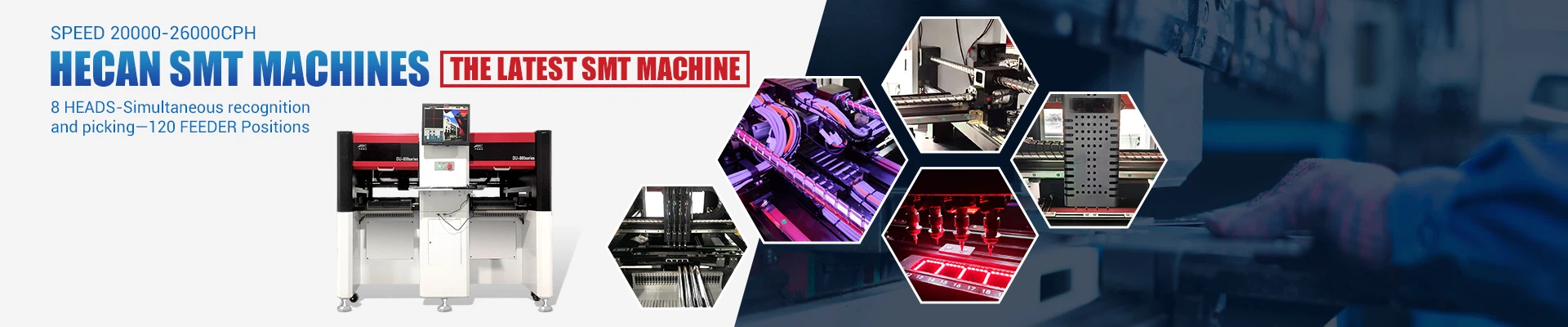
Surface Mount Technology (SMT) is a professional term in the industry for the process of surface mount assembly. Nowadays, the manufacturing of electronic products cannot do without this process. So, how does a surface mount assembly factory turn a PCB into a PCBA? Let's explain this process. Before the assembly, the factory's PMC and QC will plan the production schedule based on the production capacity and quantity. At the same time, QC will inspect the electronic components, and engineers and operators will program and debug the SMT equipment. Only after all preparations are complete can mass production begin. 1) PCB loading: Currently, fully automatic or semi-automatic PCB loading machines are used to transfer the PCB to the next SMT process equipment through a conveyor belt. The PCB loading machine belongs to the category of SMT peripheral equipment. 2) Solder paste printing: This is a crucial step in SMT assembly, as it affects the subsequent soldering quality and yield. The process involves solder paste, steel mesh, de-molding, and other techniques. The quality of solder paste printing (flatness, thickness) has an impact on the subsequent quality yield and production line throughput rate. Therefore, solder paste printing must be taken seriously. 3) SPI inspection: SPI is an inspection device used to check the yield of solder paste printing, aiming to identify potential batch soldering defects in advance and solve them. 4) SMT placement: This is the core process of SMT. The choice of SMT production line depends on the production volume and complexity of the PCBA board. If the volume is large and the components are dense, multiple SMT machines will be combined for placement to increase production capacity and efficiency. Common configurations include 2+1 and 3+1, where high-speed machines are paired with multi-functional machines for placement. 5) Reflow soldering: After placement, reflow soldering is used to melt the solder paste on the PCB pads, allowing the components to be soldered and fixed after cooling. Reflow soldering mainly consists of four temperature zones: preheating, constant temperature, heating, and cooling, each with different functions. 6) AOI inspection: AOI is an automatic optical inspection device that can replace manual inspection and improve inspection efficiency. It detects soldering quality defects. 7) Manual visual inspection: Although AOI inspection can replace manual inspection and improve efficiency, some defects may differ slightly from the pre-sampling OK board. In such cases, manual visual inspection with a magnifying glass is required for confirmation. If it is a false alarm, it can be released as an OK board. If it is indeed a soldering quality defect, rework or scrapping is necessary. 8) X-ray inspection: X-ray machines have a penetrating function and are offline devices. Due to their radiation effect, not all products undergo this process. Some products with BGA or FBGA components and high customer requirements for product reliability and stability may require this inspection. The above is the conventional SMT assembly process in surface mount assembly factories. There are countless surface mount assembly factories of all sizes, and not all of them adopt the above process. Some may directly perform solder paste printing, then placement, and then soldering, without any inspection. Such operations can be used for products with extremely low prices or low quality requirements. However, in today's highly competitive electronics market, product quality is the lifeline of customers. Therefore, regardless of the market price, it is recommended that customers choose standardized surface mount assembly factories to ensure quality.
Jul 29, 2025
Leave a message
Surface Mount Technology (SMT) Is A Professional Term in The Industry For The Process Of Surface Mount Assembly
Previous
No InformationSend Inquiry


