

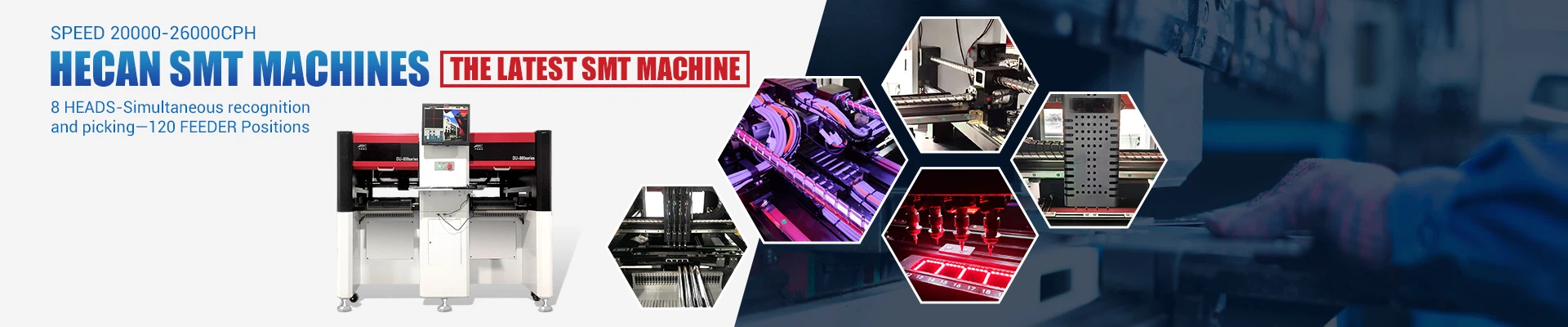
At present, with the improvement of chinese domestic step and servo system control and vision control technology, Chinese manufacturers have been able to produce simple automatic pick-and-place component placement machines. Their advantage is that they can replace relatively simple manual placement. However, for products that require angle and precision or automatic calibration during placement, domestic placement machines still have difficulty meeting the requirements.
1. Precision issue:
Currently, simple placement machines generally use step systems. For precise placement, step systems are difficult to meet the requirements of precision and speed. Of course, there are also domestic placement machines that use servo systems. The precision of servo systems comes from the precise screw and guide rail combination. Currently, domestic placement machines generally use sliding rods (which are cheaper), and the biggest problems are precision and lifespan.
2. Applicability of placement:
Imported placement machines are generally multi-axis operation systems. For example, the old machines like Samsung's CP33 and CP40 from about 8-10 years ago have a four-axis system of X/Y/Z/R axes. The precise coordination of these axes can meet the placement needs of different products. Domestic machines generally do not have a precise servo system for the Z and R axes. Because different feeding systems during component picking can affect precision, the machine needs to be able to detect and calibrate the picked components through laser or vision before placement to ensure the consistency of each product's placement.
Z-axis: For height setting, if your components have different thicknesses, the Z-axis will automatically adjust the picking and placing height through laser detection of the component thickness. R-axis: This is for angle. If your components have different angles on the PCB board, an R-axis is needed for precise angle picking and placing. This aspect needs to be added or improved in domestic placement machines.
3. Centering camera and automatic transfer system
Due to the precision issue, most domestic manufacturers have not ventured into the production of surface mount technology (SMT) placement machines. If the PCB is sent to the placement position through the transmission system, the transmission precision and the clamping plate precision can be quite different. Therefore, an automatic centering (point alignment) CCD camera is indispensable. This is because each PCB itself also has precision problems. The point alignment recognition function can calibrate this issue and thus not affect the placement precision.
Therefore, domestic surface mount machines generally do not have the automatic transfer function. Because the addition of this function, the center camera recognition system is indispensable. The machine operation software will also become more functional. The cost will also increase significantly.
Four: Device recognition and placement optimization function:
Because domestic pick-and-place machines do not have high precision requirements, they do not perform automatic identification and detection on the lifted components. That is to say, whether you place an LED 3528 or a resistor in the feeder position, the pick-and-place machine itself does not know. The machine is also unaware whether there is material on the suction nozzle or not, and it is even less clear whether the components are placed correctly. The cost of the component identification system is quite high. In this aspect, the technology of domestic pick-and-place machines that require high precision still needs to be broken through.
Placement optimization: Whether the positions for the machine to pick up and place components are the most efficient, and which component to pick up first, for multi-functional machines, the precise calculation and analysis functions of the software are the most effective. Imported surface mount technology (SMT) machines could achieve this over a decade ago, while domestic machines are still not mature in terms of software optimization for the time being.
V. Equipment Safety and Fault Diagnosis Function
The placement machine is an intelligent machine. It is very important to operate it safely. I believe that every boss wants to achieve safe production. The limit system of the placement machine and whether there is a conflict between each placement head and the X/Y/Z axes during placement are closely related to the software detection capability. In my opinion, whether a placement machine is good to use and durable, the software capability comes first, and then the hardware. With good hardware, how many years your placement machine can be used is determined by the hardware, but how many days your machine can be used is determined by the software. Remember that the software of the CP60 series dual placement system of Samsung in the early stage had problems. This is the accumulation of experience of the placement machine manufacturers.
Secondly, the simplicity of machine maintenance. Samsung does a good job in the fault diagnosis function. If there is any problem with the machine, you can tell just by looking at the interface. Before the machine starts up and enters the system, it will perform a self-check. If there is a fault that is not eliminated, it cannot be used normally. This safety awareness is very important.
Summary: Due to time constraints, I'll summarize these five aspects. When a client asked me about the technological gap between imported and domestic surface mount technology (SMT) machines, it's hard to give a precise answer. An SMT machine, which integrates mechanics, electrical control, and software, is a reflection of a country's overall strength. Maybe in ten years, or even two years, Lito could also produce domestic SMT machines that narrow the gap. What we need is to be down-to-earth and innovative. The first step will be to develop multi-functional machines, and then break through to high-speed machines. We can't just rely on advertising or speculation to develop "Made in China". I believe that Chinese people should strive to be strong.


